
The Codas Gigas:
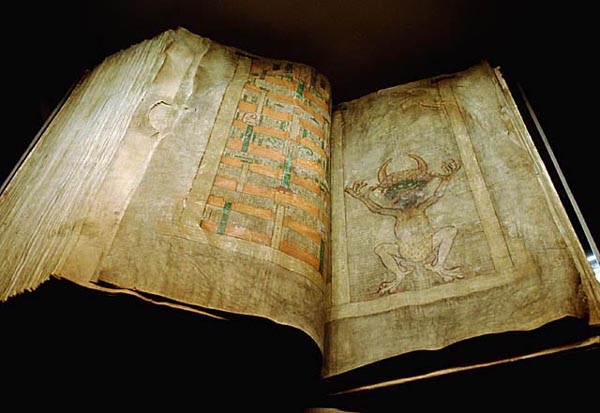
The Codex Gigas (English: Giant Book) is the largest extant medieval manuscript in the world. It was created in the early 13th century in the Benedictine monastery of Podlažice in Bohemia, and is now preserved at the National Library of Sweden in Stockholm, where two librarians are needed to lift it. It is also known as the Devil’s Bible due to a large illustration of the devil on the inside and the legend surrounding its creation.
According to legend the scribe was a monk who broke his monastic vows and was sentenced to be walled up alive. In order to forbear this harsh penalty he promised to create in one single night a book to glorify the monastery forever, including all human knowledge. Near midnight he became sure that he could not complete this task alone, so he sold his soul to the devil for help. The devil completed the manuscript and the monk added the devil’s picture out of gratitude for his aid.
Despite this legend the codex was not forbidden by the Inquisition and was studied by many scholars.
Many aspects of the legend most probably originated in truth; however, due to the large portrait of Satan which would have been unique at the time, it is likely that the legend altered the truth so that the story could be retold in a more interesting way. Anyone from the time who looked at the book would most likely be drawn to the portrait of Satan, thus getting the impression that this was one of the book’s focal points, explaining why people would believe that the monk made a pact with the devil. What many would have failed to see was that the page opposite this portrait was what is believed to be a picture of the kingdom of heaven. Now, many believe that double page spread was made to symbolize the fact that good and evil exist side-by-side, and nothing sinister.
What most likely happened is that the monk requested to produce the book in solitude, probably over a period of at least twenty to thirty years. Many monks would have used the copying of sacred texts as a method of purging their soul of evil, which could explain the monk’s motivation. The part of the legend that says that he was walled up alive as a punishment was probably a misinterpretation of his name, which is believed to be in Latin ‘Herman Inclusus’ or in English ‘Herman the Recluse’. This misinterpretation is understandable as the word ‘Inclusus’ could refer to either the punishment or voluntary solitude.

For more information on the Codas Gigas, you should all check out the official site located at: http://kb.se/codex-gigas/eng/

Can any body tell me the number of lines and then squares ruled on the page of a single page of the gigas? It would be interesting in the extreeme to me as I am looking into the astrological and numerical significance of the book
Um…I have no clue – I would go the official homepage above and ask it as those are the experts studying it.
Always glad to learn more about technology….Thanks for sharing your knowledge
hey,I discover that your website is incredibly informative and useful and we were curious if there can be a possibility of obtaining More stories like this on your web site. If you willing to assist us out, we will be willing to compensate you… Sincerely, Hai Etulain
Hi,Awesome blogging dude! i am Fed up with using RSS feeds and do you use twitter?so i can follow you there:D.
PS:Have you thought about putting video to this web site to keep the people more entertained?I think it works.Best regards, Hipolito Klimes
Hi,this is Oren Steinhoff,just identified your web-site on google and i must say this blog is great.may I quote some of the writing found in the web site to my local buddies?i’m not sure and what you think?anyway,Thanks!
Your site is very nice. I’m really excited and longing for your next article. I hope I will get it soon. Really value this post in particular. It’s tough to separate the very good from the not good sometimes, but I believe you’ve nailed it! Is it possible to write a guest articles here? I would love to share a few articles here.
This is seriously horrifying – I had no idea! I really don’t like the loss of that beautiful old-fashioned language. it genuinely upsets me to think of them not reading it all in the original. Thanks for the heads up!
this is sooo cool.
you mad freak! That’s brilliant!
Hmm you notice many of important facts. Due of this I am a weekly reader of your site.
Thanks
This is a terrific blog, I found your blog site checking yahoo for a similar subject matter and came to this. I couldnt find to much additional details on this piece of content, so it was nice to find this one. I definitely will end up being returning to look at some other articles that you have another time.
Hello. Will the admin of this site please contact me. I would like to lease some banner ads asap. My name is Dave and I work with a CPA Network. You can email me at {removed} (please respond, our network can provide much better income for the traffic you are getting than adsense) I have tried reaching you via email with no response (Sorry for the spam)
Dave, we have a contact form on our site if you are serious. https://www.10mfh.com/contact-us/
Please use that and it will be forwarded to the appropriate parties.
Thanks!